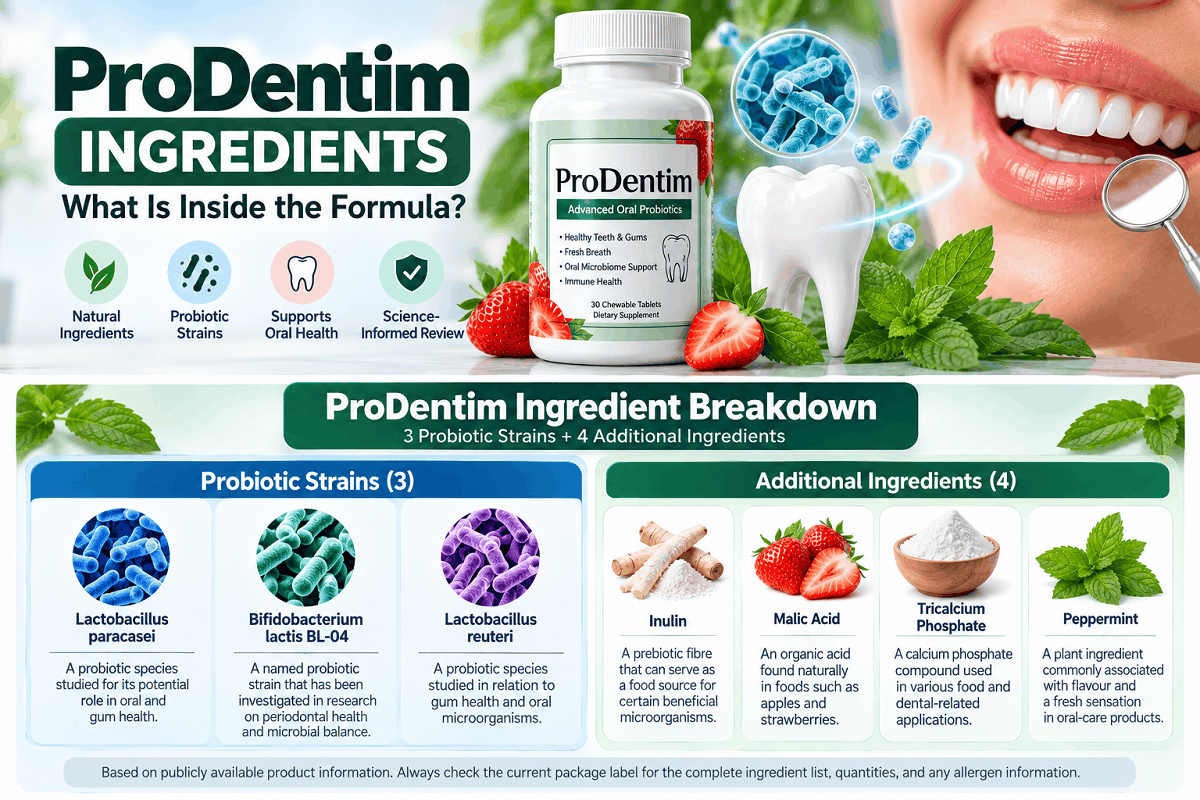

ProDentim Ingredients: What Is Inside the Formula?
A closer look at the probiotic strains and other ingredients listed in publicly available ProDentim product information.
Quick Summary
Want to Check the Current ProDentim Offer?
Review the current product information, available packages, pricing, and applicable guarantee terms directly on the product page before making a decision.
Check the Current Offer & Product Details →
Pricing, availability, and promotional terms can change. Verify the current details before purchasing.
Table of Contents
What Is ProDentim?
ProDentim is marketed as an oral probiotic dietary supplement designed to support the oral environment. Unlike conventional oral-care products such as toothpaste and mouthwash, an oral probiotic focuses on introducing selected microorganisms into the mouth.
The product information reviewed for this article highlights several probiotic strains along with additional ingredients. However, the presence of an ingredient in a supplement does not automatically establish that the finished product will produce every benefit claimed in promotional material.
That distinction is important when evaluating probiotic supplements. Research on an individual strain or ingredient is not necessarily the same as clinical evidence for the complete finished formula.
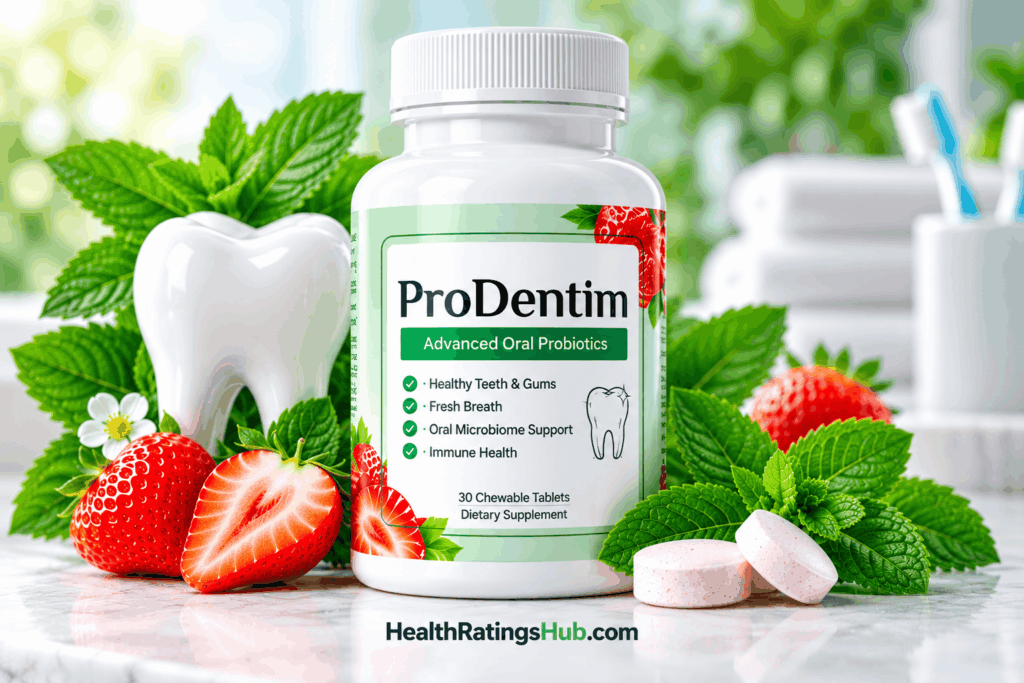
Product image shown for reference. Check the current product page and package label for the latest details.
ProDentim Ingredients
The product information reviewed for ProDentim prominently identifies three probiotic strains: Lactobacillus paracasei, Bifidobacterium lactis BL-04®, and Lactobacillus reuteri. Other ingredients discussed in the available product material include inulin, malic acid, tricalcium phosphate, and peppermint.
The exact quantity of every individual ingredient is important when evaluating a supplement, so readers should verify the current Supplement Facts panel or package label before purchasing.
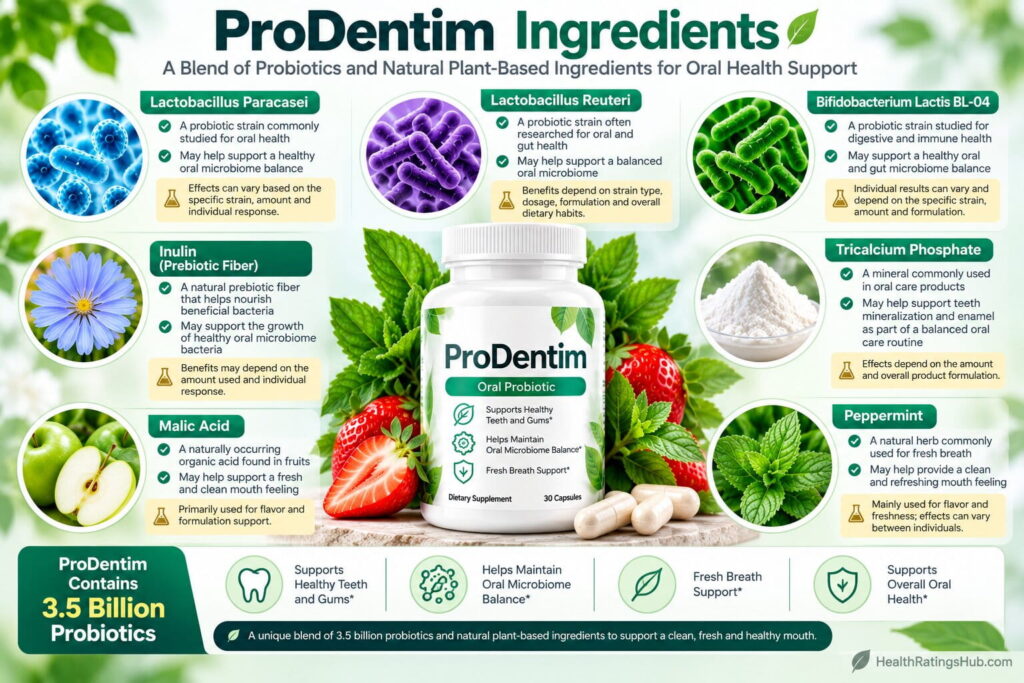
Ingredient overview based on publicly available product information. Always verify the current package label.
Lactobacillus paracasei
Lactobacillus paracasei is a probiotic species that has been investigated in relation to oral and gastrointestinal microbial environments.
Research involving probiotics can be useful when assessing whether a strain has biological potential. However, evidence involving a probiotic species or strain should not automatically be interpreted as proof that ProDentim itself produces a particular clinical outcome.
Bifidobacterium lactis BL-04®
Bifidobacterium lactis BL-04® is a named probiotic strain used in probiotic products and has been investigated in scientific research.
Research on Bifidobacterium probiotics suggests that some strains may have effects relevant to oral microbial balance, but the evidence base remains limited and varies according to the strain, dose, formulation, and study design.
Lactobacillus reuteri
Lactobacillus reuteri is one of the better-studied probiotic organisms in oral-health research. Studies have examined its use alongside conventional periodontal treatment.
A systematic review and meta-analysis found that probiotic effects can vary according to strain, duration, frequency, formulation, and other study characteristics. This means the research should be interpreted carefully rather than as proof that every L. reuteri product works in the same way.
Other Ingredients in ProDentim
| Ingredient | General role / description |
|---|---|
| Inulin | A prebiotic fiber that can serve as a food source for certain microorganisms. |
| Malic Acid | An organic acid naturally found in various fruits and used in food formulations. |
| Tricalcium Phosphate | A calcium phosphate compound used in food and supplement formulations. |
| Peppermint | Commonly associated with flavor and a fresh sensation in oral-care products. |
What Does the Research Say?
Probiotics have been investigated for possible effects on oral microbial balance, gum health, and periodontal outcomes. However, the evidence is not uniform.
A 2024 systematic review examining Lactobacillus reuteri in chronic periodontitis included 11 studies involving 369 participants. The review reported mixed findings and highlighted concerns around study quality and heterogeneity.
Other systematic reviews have similarly suggested that probiotic effects may depend on the specific strain, dose, duration, formulation, and whether probiotics are used alongside conventional periodontal treatment.
How Transparent Is the Formula?
One important point when reviewing a supplement is the difference between knowing which ingredients are present and knowing exactly how much of each ingredient is provided.
The product information reviewed provides a total probiotic amount, while exact per-strain quantities are not always clearly presented in promotional material. For this reason, buyers should inspect the current Supplement Facts panel before making a decision.
What to check:
- Current serving size
- CFU amount and whether it is guaranteed through expiration
- Individual probiotic strains
- Other ingredients
- Allergen information
- Manufacturer and contact information
Check the Current ProDentim Product Details
Product pricing, package options, availability, and guarantee terms can change. Check the current information before purchasing.
Safety & Things to Consider
Probiotics are generally studied as dietary supplements, but individual tolerance can vary. People with medical conditions, allergies, immune-system concerns, or those taking medications should discuss supplements with a qualified healthcare professional before use.
An oral probiotic should also not be considered a replacement for brushing, flossing, routine dental examinations, or professional treatment when needed.
Frequently Asked Questions
What are the main ProDentim ingredients?
The product information reviewed prominently identifies Lactobacillus paracasei, Bifidobacterium lactis BL-04®, and Lactobacillus reuteri, along with additional ingredients including inulin, malic acid, tricalcium phosphate, and peppermint.
Does ProDentim contain probiotics?
Yes. ProDentim is marketed as an oral probiotic supplement and the product information reviewed identifies several probiotic strains.
Is there clinical research on ProDentim itself?
Research exists on some individual probiotic strains and on probiotics in oral-health applications, but ingredient-level research should not be confused with a clinical trial of the complete finished ProDentim formula.
Can ProDentim replace brushing and flossing?
No. A probiotic supplement should be considered complementary to normal oral hygiene, not a replacement for brushing, flossing, professional cleanings, or dental treatment.
Final Takeaway
ProDentim combines several probiotic strains with additional ingredients intended to complement an oral-health routine. Some of the individual probiotic organisms have been studied in oral-health research, particularly Lactobacillus reuteri.
At the same time, evidence for probiotics is not uniform, and research on an individual strain does not automatically prove that the complete ProDentim formula produces the same effects.
For buyers, the most useful approach is to review the current ingredient label, understand what is known and what remains uncertain, compare the product with alternatives, and avoid treating marketing claims as guaranteed medical outcomes.
Read our complete
ProDentim Review
for a broader look at benefits, evidence, complaints, pricing, and important buyer considerations.
How We Reviewed the Ingredients
This article was prepared by reviewing publicly available product information and comparing ingredient-level claims with available scientific literature. We distinguish manufacturer/product claims from independent scientific evidence and do not claim personal product use or clinical testing.
Research Sources
PubMed — Lactobacillus reuteri and chronic periodontitis systematic review
PubMed — Bifidobacterium probiotics systematic review
PubMed — Probiotics as adjuncts to non-surgical periodontal therapy